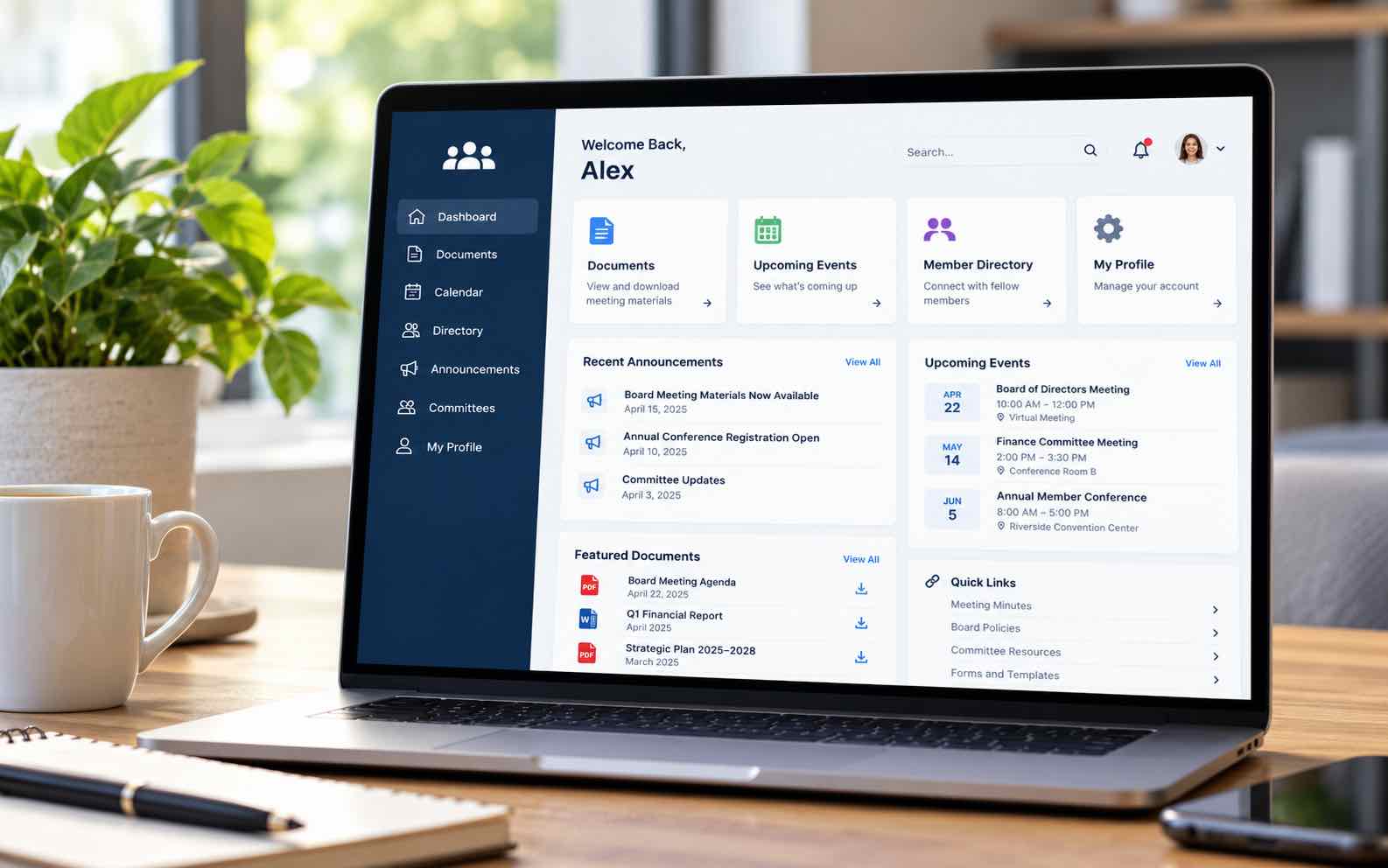
A membership portal can transform how organizations communicate, share information, and manage relationships with their members. Whether it’s a nonprofit organization, professional association, board of directors, or membership-based business, a well-designed portal provides a centralized location where authorized users can access important resources and stay connected.
Rather than relying on scattered emails, shared folders, and disconnected systems, organizations can bring essential information and functionality together within a secure, easy-to-use online environment.
Here are seven essential features to consider when developing a membership portal.
Secure Member Login and Access Controls – Security begins with ensuring that only authorized individuals can access private information. A membership portal should provide individual user accounts with secure login functionality and appropriate authentication measures. Equally important is the ability to control what different members can see and do.
For example, a nonprofit might provide board members access to financial reports while allowing committee members to view only documents relevant to their responsibilities.
Key capabilities include:
- Individual member accounts
- Secure password management
- Role-based access permissions
- Multifactor authentication options
- Administrative control over account access
These features help protect organizational information while keeping the portal convenient for authorized users.
Centralized Document Management – One of the most valuable functions of a membership portal is providing a single location for important documents. Organizations frequently distribute meeting agendas, minutes, policies, reports, and other resources through email. Over time, locating the latest version can become difficult.
A centralized document library allows organizations to:
- Organize documents by category or department
- Provide access based on membership roles
- Share updated meeting materials
- Maintain a central location for policies and resources
- Reduce reliance on email attachments
Confidential documents should be protected through appropriate access permissions rather than publicly accessible file links.
Member Directory and Profile Management – A membership portal should make it easy to manage member information. Individual profiles can contain contact details, organizational roles, committee assignments, and other relevant information.
Depending on the organization, members may also be able to update their own profiles, reducing administrative work and helping maintain accurate records.
Administrators should have the ability to approve accounts, update membership status, assign roles, and deactivate access when necessary.
Announcements and Member Communications – Keeping members informed is essential for any organization.
A membership portal can serve as a central communication hub for organizational updates, announcements, and important resources.
Useful communication features may include:
- Organization-wide announcements
- Committee-specific updates
- Email notifications
- Meeting reminders
- Notices about newly available documents
For a board of directors, these capabilities can help ensure members have convenient access to important information without searching through lengthy email conversations.
Events, Meetings, and Calendar Integration – Membership organizations often coordinate meetings, training sessions, events, and other activities. An integrated calendar provides members with a convenient way to view upcoming events and access relevant information.
Depending on the organization’s needs, a portal may support:
- Meeting schedules and calendars
- Event registration and RSVPs
- Virtual meeting links
- Agendas and supporting documents
- Automated reminders
Bringing scheduling information and related resources together helps members stay organized and prepared.
Mobile-Friendly Design and Easy Navigation – A membership portal should work just as well on smartphones and tablets as it does on desktop computers. Members may need to review documents, check announcements, or access meeting information while traveling or working remotely.
An effective portal should provide:
- Responsive layouts for all screen sizes
- Simple, intuitive navigation
- An organized member dashboard
- Easy access to frequently used resources
- Clear document categories and search functionality
The easier a portal is to navigate, the more likely members are to use it regularly.
Flexible Administration and Room for Growth – Membership portals should be designed to accommodate changing organizational requirements. An organization may initially need only secure logins and document sharing. Over time, additional functionality may become necessary.
Potential enhancements include:
- Committee-specific workspaces
- Membership applications and renewals
- Online payment processing
- Event management
- Custom forms and workflows
- Integration with existing business systems
For organizations using WordPress, a customized membership portal may offer a practical way to extend an existing website while maintaining consistent branding and centralized administration.
Choosing the Right Membership Portal for Your Organization
A successful membership portal is more than a collection of features. It should simplify administrative responsibilities, improve communication, and make important information easier for members to access.
Some organizations need only a private resource area, while others require multiple membership levels, specialized permissions, and integrations with existing systems.
Understanding these requirements before development helps ensure the portal supports both current operations and future growth.
Custom Membership Portal Development from 4Site Media Group
At 4Site Media Group, we help organizations build websites that do more than present information.
Our web design and development solutions can incorporate private membership areas, secure user access, document libraries, custom functionality, and integrations designed around specific organizational needs.
Whether you’re planning a board of directors portal, a private member resource center, or a more comprehensive membership platform, we can help you evaluate the options and develop a solution that works with your existing website.
Considering a Membership Portal for Your Organization?
Contact 4Site Media Group to discuss your requirements and explore the possibilities.