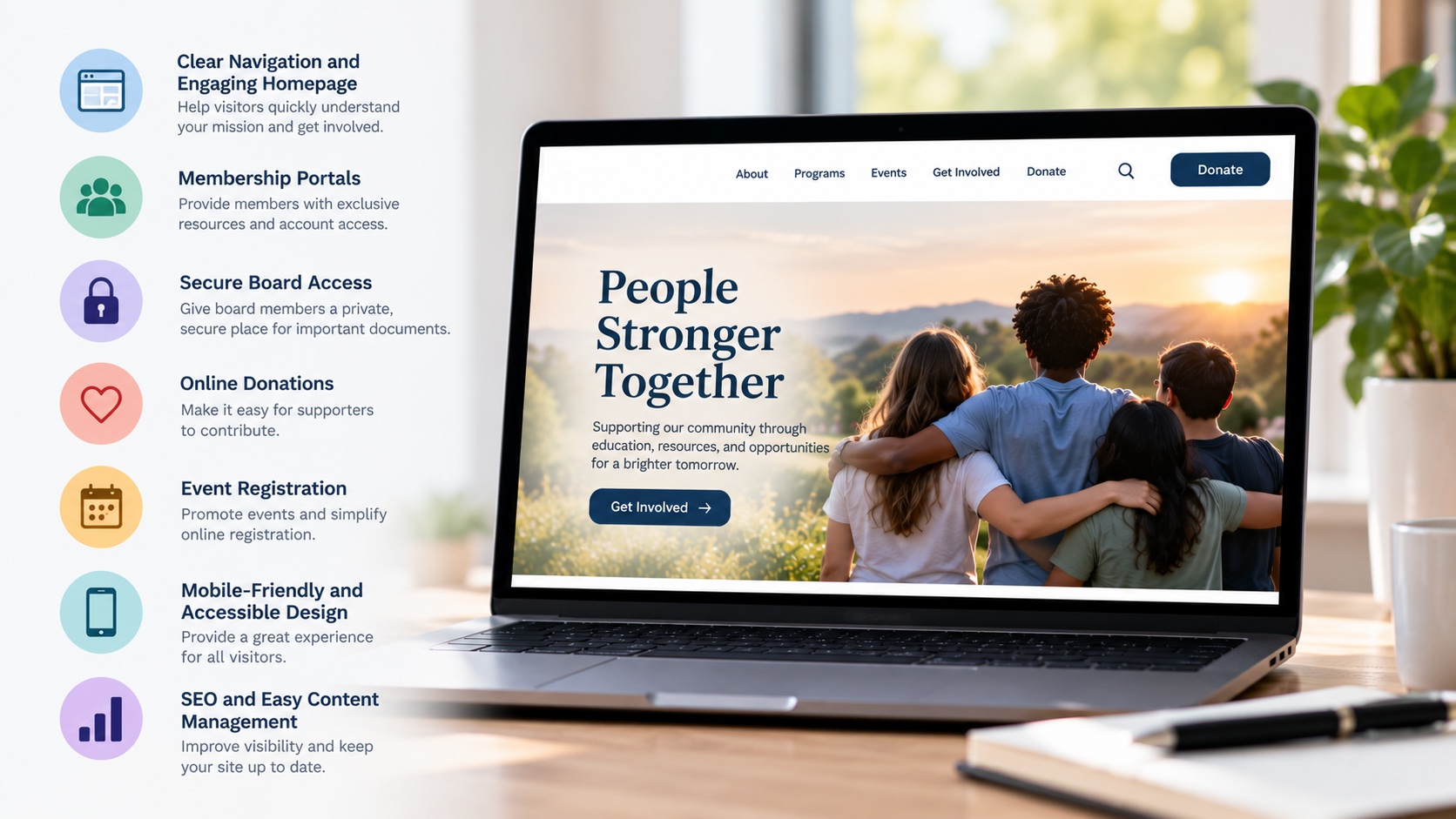
A nonprofit organization’s website should do more than explain its mission and provide contact information. It should support the people, programs, and activities that keep the organization moving forward.
As nonprofits grow, their digital needs often become more complex. Membership management, event registration, educational resources, volunteer coordination, and internal communications can quickly outgrow a basic website.
Planning a nonprofit website with long-term growth in mind means creating a flexible digital platform that can accommodate new programs, streamline administrative tasks, and provide a better experience for members, supporters, and staff.
Start With Your Organization’s Goals
Before selecting a website platform or developing new features, nonprofit organizations should identify what they want their website to accomplish.
Some organizations primarily need to communicate their mission and attract supporters. Others require more advanced functionality to manage memberships, coordinate events, distribute educational materials, or support their board of directors.
Consider questions such as:
- What are the organization’s most important goals over the next three to five years?
- Who will use the website, and what information or services will they need?
- Which administrative processes could be simplified through technology?
- Will membership, educational programs, or event participation expand?
- What functionality might be needed as the organization grows?
Answering these questions early helps establish a website strategy that supports both current operations and future opportunities.
Build a Website That Can Grow With Your Organization
One of the most important considerations in nonprofit website development is scalability.
A website may initially require only a handful of informational pages. Over time, the organization may need additional functionality, such as membership management, online learning, event registration, or secure document access.
Rather than rebuilding the website whenever new requirements arise, organizations should consider a flexible content management system that supports future expansion.
A scalable nonprofit website should make it possible to:
- Add new pages, programs, and resources without major development work.
- Introduce new functionality as organizational needs evolve.
- Integrate with membership, email marketing, and payment systems.
- Assign appropriate administrative permissions to staff and volunteers.
- Maintain consistent branding and navigation as content expands.
Planning for these capabilities from the beginning can reduce future development costs and minimize disruptions.
Consider a Membership Portal
For membership-based nonprofits, a secure online portal can become one of the website’s most valuable features.
Instead of relying on scattered emails, shared folders, and manual recordkeeping, a membership portal provides a centralized location where authorized users can access information and resources.
Depending on the organization’s needs, a portal might include:
- Member profiles and account management.
- Private directories and member resources.
- Board meeting agendas, minutes, and documents.
- Membership renewals and account notifications.
- Access to committees or specialized member groups.
- Educational materials available only to registered members.
Role-based permissions are particularly important. Board members, general members, administrators, and committee representatives may require different levels of access.
A well-planned portal provides the appropriate information to each user without making website administration unnecessarily complicated.
Integrate Event Management Into the Website
Events play an important role in many nonprofit organizations. Conferences, educational workshops, fundraisers, networking opportunities, and member meetings all require coordination.
An integrated event calendar makes it easier for visitors and members to discover upcoming activities while reducing the administrative work involved in managing registrations.
Useful event management capabilities may include:
- A searchable calendar of upcoming events.
- Online registration and payment processing.
- Member-specific event pricing or access.
- Automated registration confirmations and reminders.
- Attendance tracking and reporting.
- Integration with email communications.
When event management connects directly to the organization’s website and membership system, administrators can manage information more efficiently while providing a consistent experience for participants.
Create Opportunities for Online Learning
Educational programming is another area where nonprofit websites can provide long-term value.
Organizations that offer professional development, member training, workshops, or educational presentations can benefit from an integrated online learning environment.
An online learning center might include recorded webinars, instructional videos, downloadable materials, self-paced courses, and assessments.
Depending on the organization’s goals, additional functionality could include course enrollment, completion tracking, certificates, and restricted access based on membership level.
Online learning also allows nonprofits to extend the reach of their educational programs beyond in-person events.
Members who cannot attend a live presentation may still be able to access valuable content on their own schedules.
By incorporating online learning into the website, organizations can build a growing library of resources that continues to provide value over time.
Make Website Administration Simple
Nonprofit organizations often operate with limited staff, volunteers, and administrative resources. A website that requires technical assistance for every routine update can become expensive and difficult to maintain.
An effective website should make common administrative tasks straightforward.
Authorized team members should be able to update content, publish announcements, add events, manage resources, and maintain member information without extensive technical knowledge.
It’s also important to consider how responsibilities may change over time.
Staff transitions, new board members, and changing volunteer roles should not create unnecessary complications when managing the website.
Clear administrative permissions, documentation, and training can help ensure continuity.
Prioritize Security, Accessibility, and Reliability
As nonprofit websites become more interactive, security and accessibility become increasingly important.
Membership portals may contain personal information, while event registration systems and payment integrations can involve sensitive transactions.
Organizations should consider secure authentication, appropriate user permissions, regular software updates, backups, and reliable hosting.
Accessibility is equally important. Website navigation, content, forms, and educational resources should be designed to accommodate users with different abilities.
Following recognized accessibility standards, such as the Web Content Accessibility Guidelines (WCAG), can help organizations create a more inclusive digital experience.
These considerations should be incorporated into the planning process rather than addressed only after the website launches.
Connect Your Website With Other Digital Tools
A nonprofit website rarely operates independently.
Organizations may already use email marketing platforms, donor management systems, customer relationship management software, payment processors, or accounting applications.
Connecting these tools can help reduce duplicate data entry and improve operational efficiency.
For example, a new membership registration might automatically update the organization’s member database and trigger a welcome email. Event registrations could generate confirmation messages and populate attendance records.
The specific integrations will depend on the organization’s existing systems and operational requirements.
The objective is to create a connected digital environment where information can move efficiently between platforms.
Plan for Ongoing Improvement
Launching a new nonprofit website is an important milestone, but it should not be viewed as the end of the project.
Organizations change. New programs emerge, membership needs evolve, and technology continues to advance.
Regular website reviews can help identify opportunities to improve navigation, update content, introduce new functionality, and streamline administrative processes.
Website analytics, member feedback, event participation, and online learning engagement can provide useful insights into how the platform is performing.
An ongoing improvement strategy helps ensure that the website remains relevant and valuable as the organization grows.
Building a Stronger Digital Foundation for Your Nonprofit
A successful nonprofit website is more than a collection of pages. It can serve as a central platform for communication, member engagement, event management, education, and organizational operations.
By planning for scalability, security, usability, and integration from the beginning, nonprofit organizations can create a website that supports their immediate needs while remaining flexible enough for future growth.
At 4Site Media Group, we help organizations plan and develop websites that combine professional design with practical functionality. From membership portals and event management to online learning and integrated digital solutions, our approach focuses on building platforms that support organizational goals and long-term success.
Planning a new website for your non profit organization or considering an upgrade to your existing platform? Contact 4Site Media Group to discuss how a more connected digital solution can support your organization.